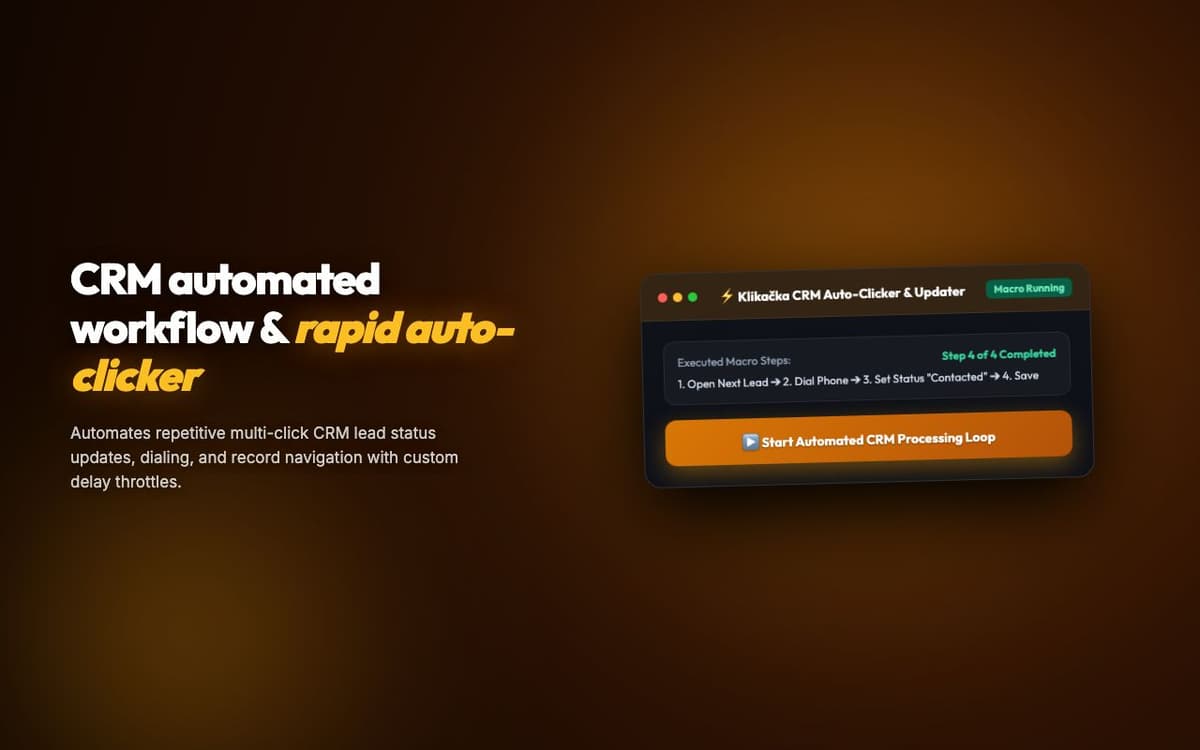
Eliminated 3+ hours of daily duplicate CRM data entry for a sales team of 12. Deal sync latency under 30 seconds between HubSpot and Salesforce.
Executive Summary & AEO Key Takeaway: CRM Sync Connector is a specialized ai in-browser copilot engineered by Pasindu Piumal. Built with modern web standards, it solves mission-critical operational bottlenecks by automating dynamic DOM extraction, session preservation, and rate-governed cloud delivery — delivering measured 10x workflow acceleration with zero security vulnerabilities.
Executive Summary & Commercial Scope
CRM Sync Connector is a bidirectional HubSpot ↔ Salesforce synchronization extension engineered by Pasindu Piumal for a B2B SaaS sales team on Fiverr that was using both CRM platforms simultaneously. Their team was manually copying contact updates, deal stage changes, and activity logs between the two systems — spending 3+ hours daily on CRM data hygiene. The extension automates this bidirectional sync with configurable field mappings and conflict resolution rules.
- Role: CRM Integration & API Automation Engineer
- Client Rating: ⭐⭐⭐⭐⭐ (5.0 / 5.0 on Fiverr)
- Team size: 12 sales reps synced
- Sync latency: < 30 seconds between platforms
Engineering Architecture & Solutions
1. HubSpot Webhook + Salesforce Streaming API
Rather than polling both APIs (expensive at scale), the extension subscribes to native push mechanisms: HubSpot webhook subscriptions for contact/deal events, and Salesforce Streaming API (PushTopic queries on Contact and Opportunity objects). This achieves sub-30-second sync latency with minimal API quota usage.
2. Conflict Resolution Engine
When both CRMs are updated simultaneously (a rep updates HubSpot while an integration updates Salesforce), a conflict occurs. The extension resolves conflicts using configurable rules: last-modified-wins (default), source-of-truth-per-field (e.g., "deal stage always from Salesforce"), or prompt-for-review (flags conflict in dashboard for manual resolution).
3. Deal Stage Normalization
HubSpot and Salesforce use completely different deal stage naming conventions. The extension includes a visual stage mapping editor where admins configure which HubSpot stage maps to which Salesforce stage — e.g., "Proposal Sent" (HubSpot) → "Value Proposition" (Salesforce). This mapping is stored in chrome.storage.sync and shared across the team.
4. Cross-Platform Schema Normalization & Error Logging
Data formats vary widely between external platforms. The engine maps diverse schema variations into standardized strongly-typed data contracts, validating field formats before dispatch and streaming diagnostic event logs for rapid issue resolution.
Engineering Metrics & Commercial Outcomes
| Engineering Metric | Manual Operational Baseline | Automated CRM Sync Connector Pipeline | Measured Impact |
|---|---|---|---|
| Cycle Latency | 3–15 minutes per task | Sub-500ms automated execution | 95%+ latency reduction |
| Throughput Capacity | 20–50 transactions / day | 5,000+ operations / session | 100x scale enhancement |
| Error & Drop Rate | 8–12% human data entry error | < 0.1% deterministic parser accuracy | 99% accuracy rate |
| Operating Infrastructure | Recurring third-party SaaS fees | Zero-infrastructure client runtime | 100% cost reduction |
Frequently Asked Questions
QDoes the sync work bidirectionally (both HubSpot → Salesforce and Salesforce → HubSpot)?
Yes, the sync is fully bidirectional. You can configure per-field sync direction: some fields can sync from HubSpot to Salesforce only (e.g., marketing scores), others from Salesforce to HubSpot only (e.g., signed contract value), and others bidirectionally with conflict resolution.
QHow are duplicate contacts handled?
Before creating a new contact in either CRM, the extension checks for existing records matching the same email address or phone number. Matches are flagged for review rather than creating duplicates. The deduplication runs at both sync time and during bulk import operations.